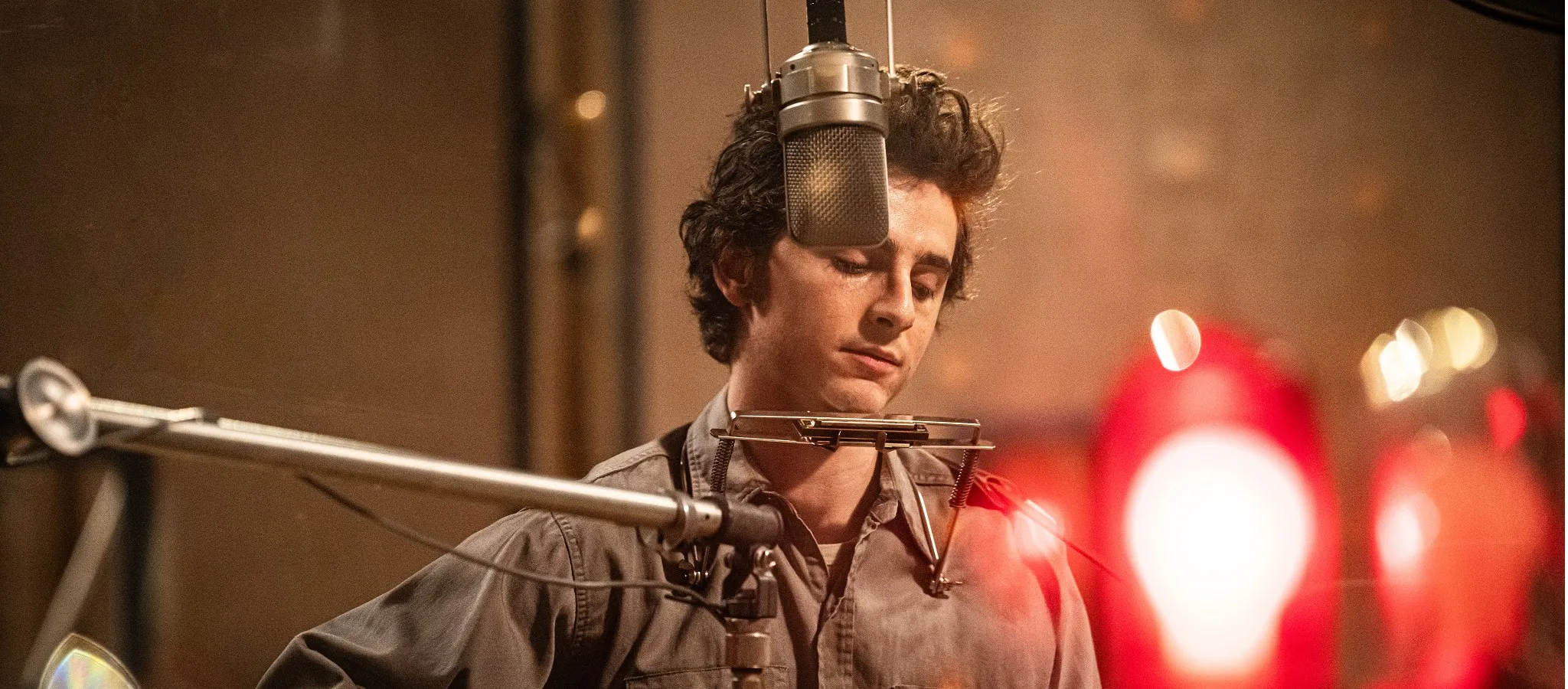

In this “review” that nobody asked for, I shall make a lousy yet sincere attempt to articulate my thoughts about the much awaited biopic of an artist I revere. If I succeed at nothing else I shall do my best to make it all about me. There are spoilers here, you have been cautioned.
I don’t watch rock biopics.
It is not because I am a stickler for accuracy who is incapable of forgiving the artistic liberties a filmmaker may take with the life story of a musical idol of mine. That would be foolish, because there is no one accurate version of a rockstar’s story, only threads of invention loosely woven together by tiny sprinklings of the truth. People invent stories for themselves, especially in the music business.
No, there is a far simpler, more egotistic reason. Being subjects of my idolatry, musicians like Dylan, Bowie, and The Beatles — to name a few in a long list — occupy a cogent emotional space in my mind. My own personal biopics for each of them, if you like, with my own version of the truth. I don’t like anyone else messing with it.
I hadn’t been planning on watching A Complete Unknown, that is, until I heard the soundtrack. Two of my dylanophile friends had a part to play in it too, and in the days leading up to the screening, I remember sharing my apprehension with one of them. He said, “I have no expectations for the film. I’m just happy to have a film about Bob.”
“Well, I’d rather have no film than a crap film,” I replied.
I’ve said elsewhere that my fondness for Dylan borders on veneration, although I was not part of the generation that grew up listening to him or his peers. Through no fault of my own, I was born too late, and too far away. But I’ve often fantasised about the mythical New York of the 60s — the New York of the beatniks and the conscientious objectors — and what it would have been like to live there. At the centre of the universe. Sobering depictions of the reality of this period, à la Midnight Cowboy, have not quelled my romanticism. A Complete Unknown begins by transporting us to this New York I’ve always dreamed of.
Played by a Timothée Chalamet who hasn’t shaken his Dune-face, Bobby travels to Greystone to meet his bedridden hero Woody Guthrie. He’s met with Woody’s approval, and Pete Seeger’s too. Seeger’s presence at this meeting is fabricated, but it serves the plot, and I have no qualm with it. What then ensues is a story told largely through reactions — reactions of music execs, love interests, and the adoring public to Bob’s songs. This in itself is not a complaint, but I cannot forgive James Mangold for the reductive approach with which some songwriting sequences are treated. Seeing a leaf blowing in the wind may well have inspired a song title, we’d never know, but distilling any work of art to singular moments like these is rather dismissive.
This brings me to another reservation of mine with biopics. Film is a limited medium, with the self imposed restriction of having to follow a sensible plot, with a beginning, a middle and an end. To capture the multitudinous life of an artist who is only just starting out is impossible in such a medium. Impossible, that is, without making a few sacrifices, and making it look like things always follow a clear logical path, when real life rarely unfolds that way.
Would I rather not have had a film made about a personal idol? (he says, as if the world revolves around him.) I wouldn’t say that. In fact I’m glad this film got made, and glad to have watched it. I may also have been unfairly harsh to Chalamet earlier. He’s excellent in this film, and so is the supporting cast. Edward Norton disappears into his role, as ever, and while I believe no mortal can ever mimic the hauntingly angelic quality of Joan Baez’s voice, Monica Barbaro comes close. Boyd Holbrook is thoroughly entertaining as a suave Johnny Cash. Dan Fogler’s Albert Grossman is as sleazy as the real man was infamous for being. Liberties are taken with events (The Times They Are A-Changin\’ wasn’t played at Newport 64, but it makes for a great moment in the film), characters (Elle Fanning’s Sylvie Russo is a made up character based on Suze Rotolo, out of respect for Bob’s wishes) but I’m not so petty as to not forgive them.
I wouldn’t say I loved the film, but I watched it twice. Once at the local indie cinema I frequent several times a week, and again on the IMAX screen I can only justify the expense for when ‘cinematic events’ happen. This film clearly is one. It deserves to be seen projected. When you visit your favourite cinema to see it, I hope they’d play it loud, because the real gift of this film is the soundtrack, and the fact that Bob’s music is now reaching younger audiences with Chalamet in the role of a worthy custodian. I’m still iffy on rock biopics, and may never see one again, but there is no denying that great music lives on through them. Bob’s music will outlive us all.
Leave a Reply