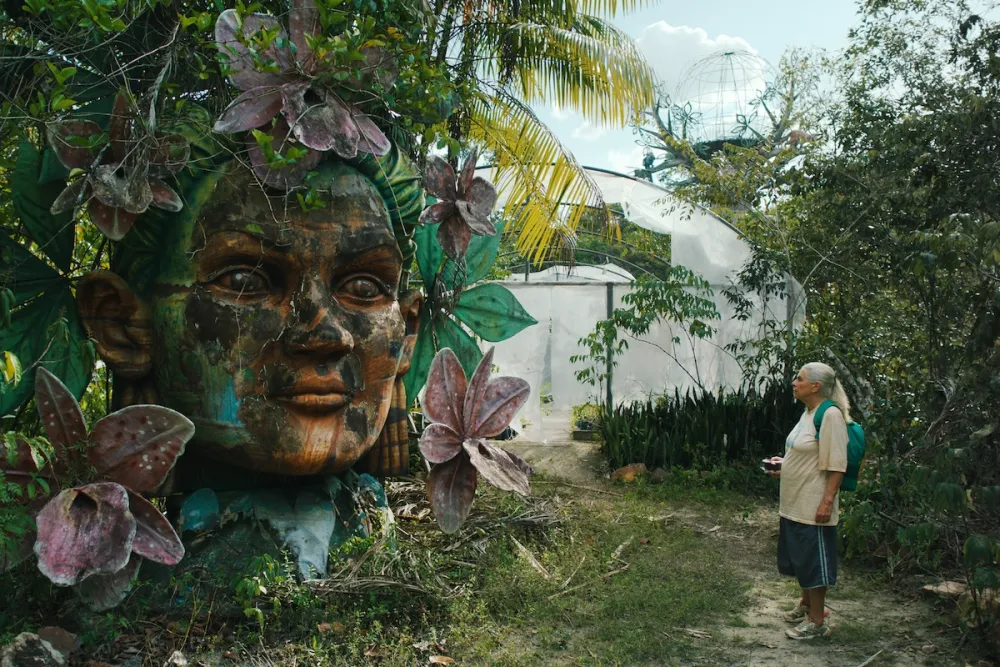

This is a slightly altered version of my review of the film The Blue Trail originally published on Letterboxd.
Two of my favourite films this year so far are from Brazil—The Blue Trail, and The Secret Agent. Both feature individuals on a similar journey, in that they are desperately trying to escape the tyrannical grasp of a corrupt authority, while meeting colourful characters along the way.
Hired killers haunt Armando’s footsteps in The Secret Agent, but in The Blue Trail the whole world seems to be against Tereza. The threat is not immediately apparent, but always bubbling beneath the surface. Except for a few appearances of (almost genial) police officers, we never see any shady government agents or crass displays of authoritarianism in Mascaro’s dystopian Brazil, simply because they’re not required when the population has so effectively been deputised. Mundane tasks require “documents,” and they’re demanded by shop owners, travel agents, and ticket sellers. Petty bureaucrats are emboldened to deal out repression in small doses, and the public just accepts it.
The faces on screen in The Blue Trail, like those in The Secret Agent, look like real peoples’. Hollywood has conditioned us to expect movie-star good looks from every actor, but having been made outside the American mainstream, these films are not bound by the same rules. Our protagonists are also not heroic in the traditional sense. Armando is a university professor. Tereza is factory worker. They’re both ordinary, unremarkable even. No grand acts of revolution are required of them in the face of banal oppression; their existence is their rebellion. Walter Salles made a similar statement recently with I’m Still Here, and it’s interesting to see two more films dealing with similar themes come out of Brazil an year later. There’s something in the air, a certain yearning, a call for catharsis through art in a deeply troubled country that seems to demand it of its artists.
The Secret Agent is a period piece (for the most part), The Blue Trail is set in the not too distant future, and I’m Still Here weaves a thread from one to the other. They have very different endings, but they’re all powerful. The cycle of oppression is never-ending. You may be afforded brief spells of respite, but you can never fully escape tyranny: if you don’t fall in, or buy your way out, all that awaits you is (literal or figurative) death.
Leave a Reply