//In Everything Else
The Odyssey (2026): a review
My thoughts on Christopher Nolan's blockbuster adaptation of the Greek epic
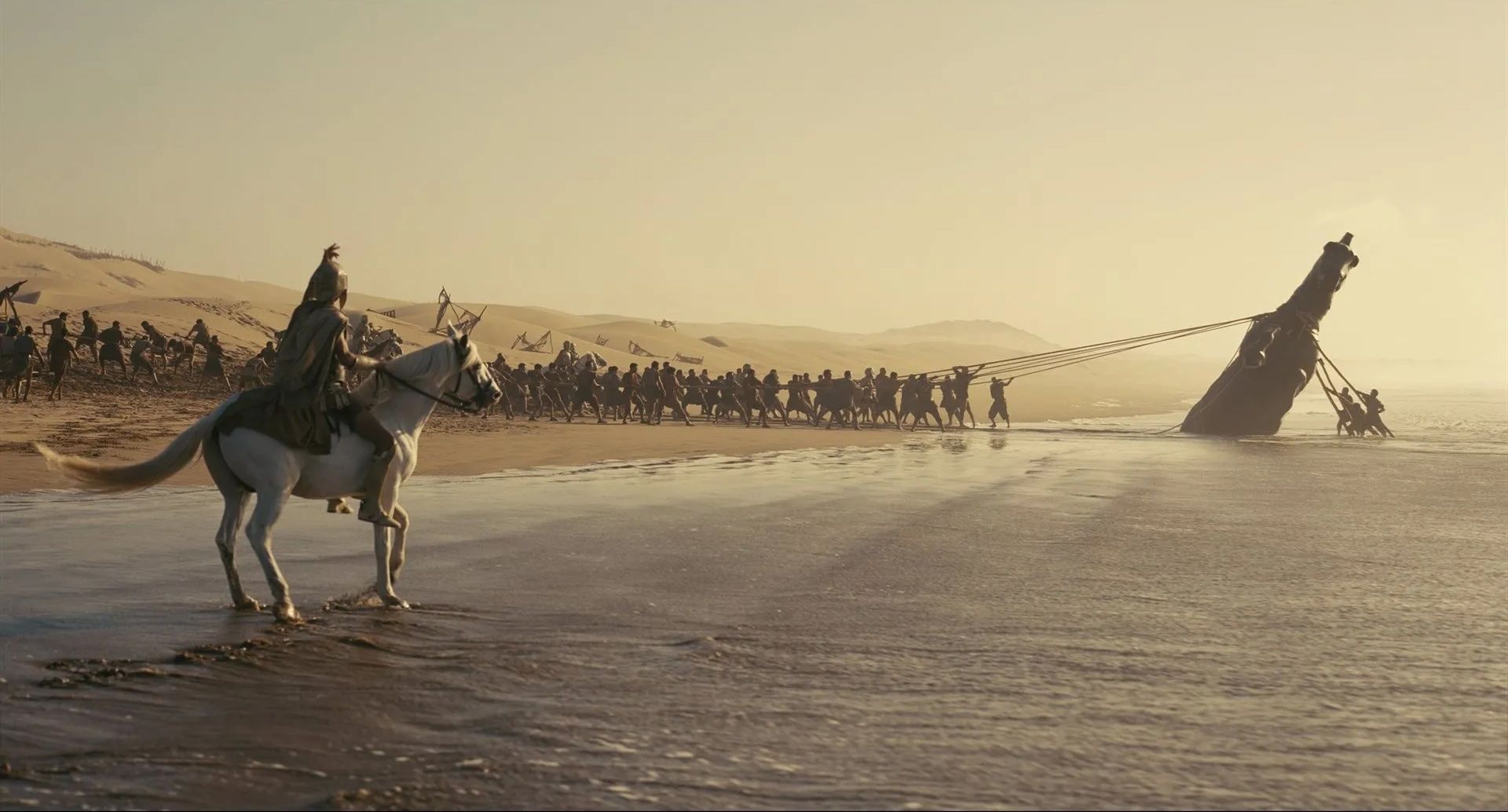
This review contains spoilers.
In O Brother, Where Art Thou? Ulysses Everett McGill lies to his companions and tricks them into fleeing a chain gang with him. Through numerous ordeals (including a barn-burning, sirens, and even a one-eyed cyclops Bible salesman) he keeps up the lie, promising them a buried treasure that does not exist. His true calling is his home, and his wife, but it’s not love that drives him. It’s jealousy. It’s insecurity. Ulysses Everett McGill is a complicated man. A manipulator.
The story is loosely based on the Homeric epic and features many not-so-subtle hints to the bard’s creation, including the main character’s name. For years it has been one of my favourite Coen Brothers outings, and I’ve always thought of it as an inspired adaptation. Imagine my excitement when I heard a new adaptation of the story was coming to cinemas with a $250 million price tag attached to it.
In an interview, Christopher Nolan called Odysseus “wily and complicated”. Yet in his big screen adaptation of The Odyssey, Matt Damon plays an endearing hero, not a complicated man. Nolan chose to write the Greek warrior as a salt-of-the-earth leader of men. A guilt-racked war veteran. A soldier wrestling with PTSD. It is a modern retelling of the story in more ways than one.
When I read the Rieu translation of the poem at far too young an age, I didn’t think of it as much of a morality tale. If any inkling of Odysseus’ overbearing guilt existed in the text, it was lost on me completely. I was reading tales of adventure, I thought, of war and turmoil, and of a proud man. For those unfamiliar, this is the opening line:
The hero of the tale which I beg the Muse to help me tell is that resourceful man who roamed the wide world after he had sacked the holy citadel of Troy.
Other translations, which I’ve since learned are widely accepted to be better, opt for slightly different wording. Here is Robert Fagles:
Sing to me of the man, Muse, the man of twists and turns … driven time and again off course, once he had plundered the hallowed heights of Troy.
And more recently, Emily Wilson:
Tell me about a complicated man. Muse, tell me how he wandered and was lost when he had wrecked the holy town of Troy.
On a character widely accepted to personify resourcefulness, complexity, and ruthlessness (his was the master plan that resulted in the fall of Troy), penitence is a new colour. Nolan’s (and Damon’s) Odysseus is far too likable to be interesting. He is troubled by his sins, haunted by visions of Athena who pokes at his guilty conscience, and determined to get home. The scheming, pillaging, adulterous Odysseus from the text does not exist in Nolan’s script. He is a victim, a good man with a heart of gold, and is ultimately quite boring.
One thing to note here is that Nolan’s Odysseus would not exist without Nolan’s Oppenheimer. But the same internal struggle that made Oppenheimer’s journey a gripping tale somehow does not work as well when ported over to Ancient Greece. The retrospective application of our modern moral sensibilities of war and conquest on societies that seem to have thrived on such enterprises is, in my mind, futile. And in the context of filmmaking, it lacks entertainment value.
At the end of the film, our triumphant hero sails into the sunset with the wife he so yearned to get back to. Tolkien-esque dialogue ensues. All is well in the world. You couldn’t have asked for a more Hollywood ending.
Setting aside my complaints about Nolan’s watering down of a violent tale from a forgotten age, a few other choices he had made left me wanting. While I appreciate a certain amount of setting up is needed for general movie-going audiences who may not be acquainted with the story, I found the chunks of expository dialogue in the first act to be quite dull. And for a story that pits a man against gods and monsters, we didn’t see much of either. We’re left with the scraps of a reluctant warrior’s emotional unrest, which in itself is not as satiating as the whole meal could have been.
Why, then, am I going to see this film a second time? Why fly to London specially, to experience it in the biggest and ‘purest’ format (IMAX 70mm film, in this instance) possible? The answer to these questions is rooted in my love for the medium itself.
The Odyssey is a remarkable achievement in filmmaking. A three-hour epic, shot entirely on IMAX film, on location, with extraordinary in-camera effects: only Nolan could have taken all that on and delivered a monumental box office success. And although quite grey—both literally and in the way it chooses to tell its story—the film looked gorgeous on the big screen. Ludwig Göransson’s score was spine-tingling and tear-inducing in the appropriate places. Agamemnon’s Darth Vader armour would have looked completely alien to the Achaeans laying siege to Troy, but it effectively conveys his power and hubris, and looks menacing on screen.
Despite all my grumbling, I still am grateful this world was brought to the big screen. Nolan does not just make films; his speciality is in crafting cinematic events, whether he intends to or not. His stubborn insistence on using practical effects and shooting on premium formats may not always translate well on screen, but you can’t help but admire the gall. Most importantly, his films bring people to the cinemas in droves. Classicist and translator Emily Wilson couldn’t help but concur in her scathing review of the film, titled An Uncomplicated Man. She says:
Despite all this, the release of The Odyssey is still an event to celebrate. In what we are told is the streaming era, this epic is bringing audiences back to cinemas. In what we are told is a time of declining literacy and the ‘death of the humanities’, translations of The Odyssey, including mine, are flying off the shelves. Some of those who buy the book or show up in cinemas to watch Tom Holland may go on to study ancient Greek. Perhaps the film will persuade a few college administrators not to cut their literature, language and history departments. Nolan, who studied English at University College London – where students still study The Odyssey as a first year ‘foundational text’ – is doing his best to get the general public reading again, and I am grateful.
With O Brother, Where Art Thou? the Coen Brothers did a more stimulating adaptation of the story, in my opinion, but it would be unfair to suggest that Nolan had no right to interpret the story his way. I might warm to it more on repeated viewings.
Reference this post: When referencing this post, I prefer to be called Thamara, Thamara Kandabada, or Thamara's Notebook.


